

A low Not-to-Exceed limit feels like a safeguard, but on a commercial kitchen repair, it can do the opposite. When a technician hits the cap mid-repair, the job stops, a quote gets generated, and the equipment sits down while everyone waits on approval. This piece breaks down what that delay actually costs — the extra trips, the admin, the lost revenue while a combi oven or ice machine is out of service — and makes the case for tracking total cost to resolution instead of just the invoice total. The fix isn't eliminating spending controls, it's setting smarter ones: giving trusted service partners the authorization to finish the job the first time.
Not-to-Exceed limits are designed to control costs. But in commercial foodservice, could a low NTE actually be costing operators more?
It is a conversation we believe the industry needs to have.
In this article
- What actually happens when a repair hits its NTE mid-visit
- The hidden costs an invoice never shows
- Why "total cost to resolution" is the number that matters
The $750 Call That Doesn't Get Fixed
Imagine a Rational combi oven goes down. It is leaking water and the kitchen cannot operate normally.
The service call is dispatched with a $750 NTE.
A qualified technician arrives, diagnoses the problem and determines that the repair requires parts and additional labor. The repair cannot be completed within the $750 authorization.
So what happens?
The technician stops. The service company has to generate a quote. That quote may need to be entered into its own service management system and a third-party customer portal. Office personnel get involved. The quote is submitted for approval. Everyone waits.
The technician moves on to another call.
The equipment remains down. And the clock keeps running.

The NTE Was Supposed to Control Costs
We understand why NTEs exist. Operators and facilities teams need financial controls. Nobody wants an open-ended service call or an unexpected repair bill.
But there is a difference between controlling the cost of a repair and controlling the total cost of an equipment failure. Those are not always the same thing.
A 2026 Aquant field-service benchmark analyzed nearly 30 million service events across 161 organizations and found that the industry average first-time-fix rate was 77%. More importantly, failed visits represented 25% of total service costs at the median and as much as 44% among lower-performing organizations.
The lesson is simple: every time we send a technician to a site without the ability to complete the work, we increase the cost of getting that equipment back into operation.
Industry average
First-time-fix rate across nearly 30 million field service events
Of total service cost
Can come from failed visits at lower-performing organizations
Average callback cost
When technician time, overhead and lost opportunity are counted
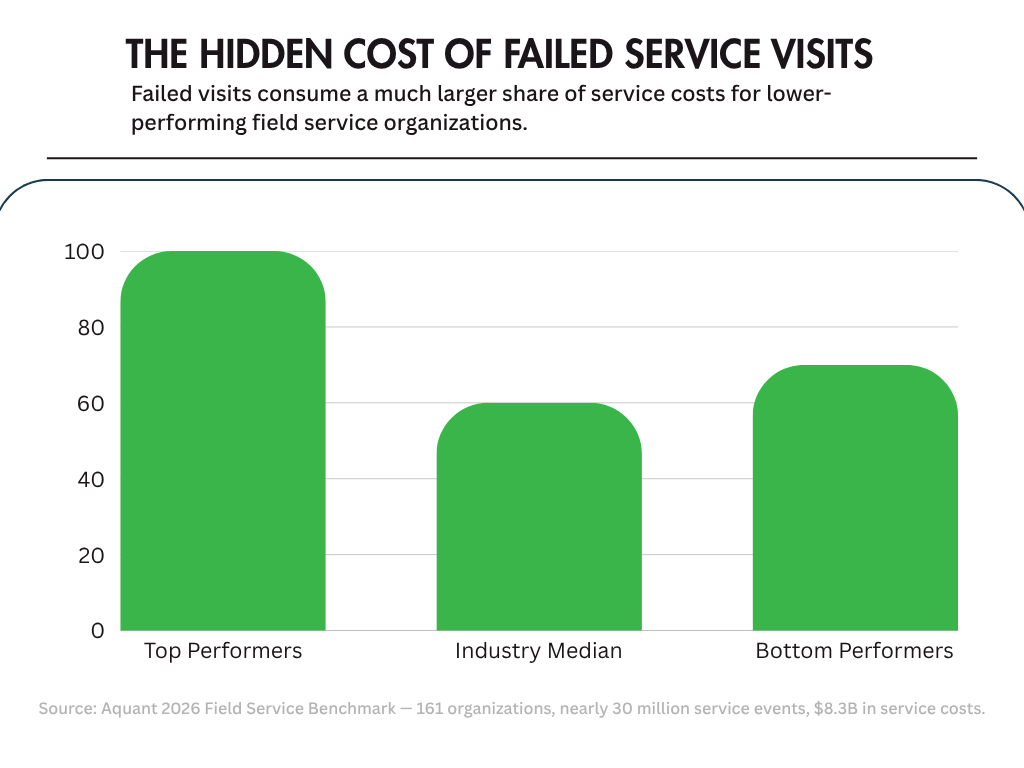
The hidden cost of failed service visits.
The Hidden Cost Nobody Sees
The invoice might say $750. But the actual cost of the delay can be much higher.
What actually gets spent while the quote sits in a queue
- The technician's time
- The truck, fuel and tolls
- Insurance and inventory
- Dispatch and management time
- Parts and quoting administration
- Portal administration
- Billing delays
- Another trip to the restaurant
And, most importantly, the customer's equipment is still down.
The Air Conditioning Contractors of America has documented this same problem in the HVAC industry, estimating a typical service callback costs approximately $650 once technician time, office overhead and lost opportunity are included.
Commercial foodservice has an additional problem: the equipment often directly produces revenue. A 2026 survey of more than 400 U.S. restaurant leaders found that 49% had experienced downtime from equipment failure or unplanned maintenance. Nearly one-quarter estimated their revenue loss at $1,001 to $5,000 per hour during a disruption.
Have been hit
Of restaurant leaders surveyed experienced downtime from equipment failure
Lost per hour
Estimated revenue loss during a disruption, for nearly a quarter of those surveyed
So if a $750 NTE prevents a $1,500 repair from being completed today, did we really save money? Or did we simply move the cost somewhere else?

We Need to Measure Total Cost to Resolution
At Malachy Parts & Service, we believe the industry should look beyond the individual service invoice and start measuring total cost to resolution.
How many trips did it take?
How many technician hours?
How much administrative time?
How long was the equipment down?
How many approvals were required?
How long did the customer wait?
And what revenue or productivity was lost while the equipment was unavailable?
That is the number that matters. A repair that could have been diagnosed, quoted and completed in one visit should not routinely become two, three or four separate administrative and field events simply because the initial authorization was too low.
There Is a Better Conversation
We're not suggesting eliminating financial controls. We're suggesting smarter ones.
Give trusted service partners reasonable authorization levels based on equipment type, repair history and the real cost of getting the job completed. Allow qualified technicians to resolve common repairs without stopping the process for another round of approvals.
Because the goal shouldn't be "how little can we authorize on this service call?" The goal should be "how quickly and efficiently can we get this equipment back in service?"
At the end of the day, the restaurant doesn't care about the NTE. They care that the combi oven works. And so do we.